
A plant-food ledger, built for the US and usable anywhere. For any plant food or plate of foods, it shows what's in it, what your body can actually use, and the plant defence chemistry that comes with it: each compound with its dose, its safety threshold and how good the evidence is. US food names, spelling and daily amounts are the defaults; daily amounts can be switched to the UK, EU (EFSA), Australia/New Zealand or WHO, and the safety limits come mainly from EFSA (EU) and JECFA (FAO/WHO).
- People argue about plants with half-remembered claims: "spinach blocks calcium", "apple seeds have cyanide", "rice has arsenic". An AI summary can say "it depends on the amount", but it can't work out the amount. vegwars works out the figure for the portion and plate in front of you, and for your body weight, against a named safety limit, with the source beside every number.
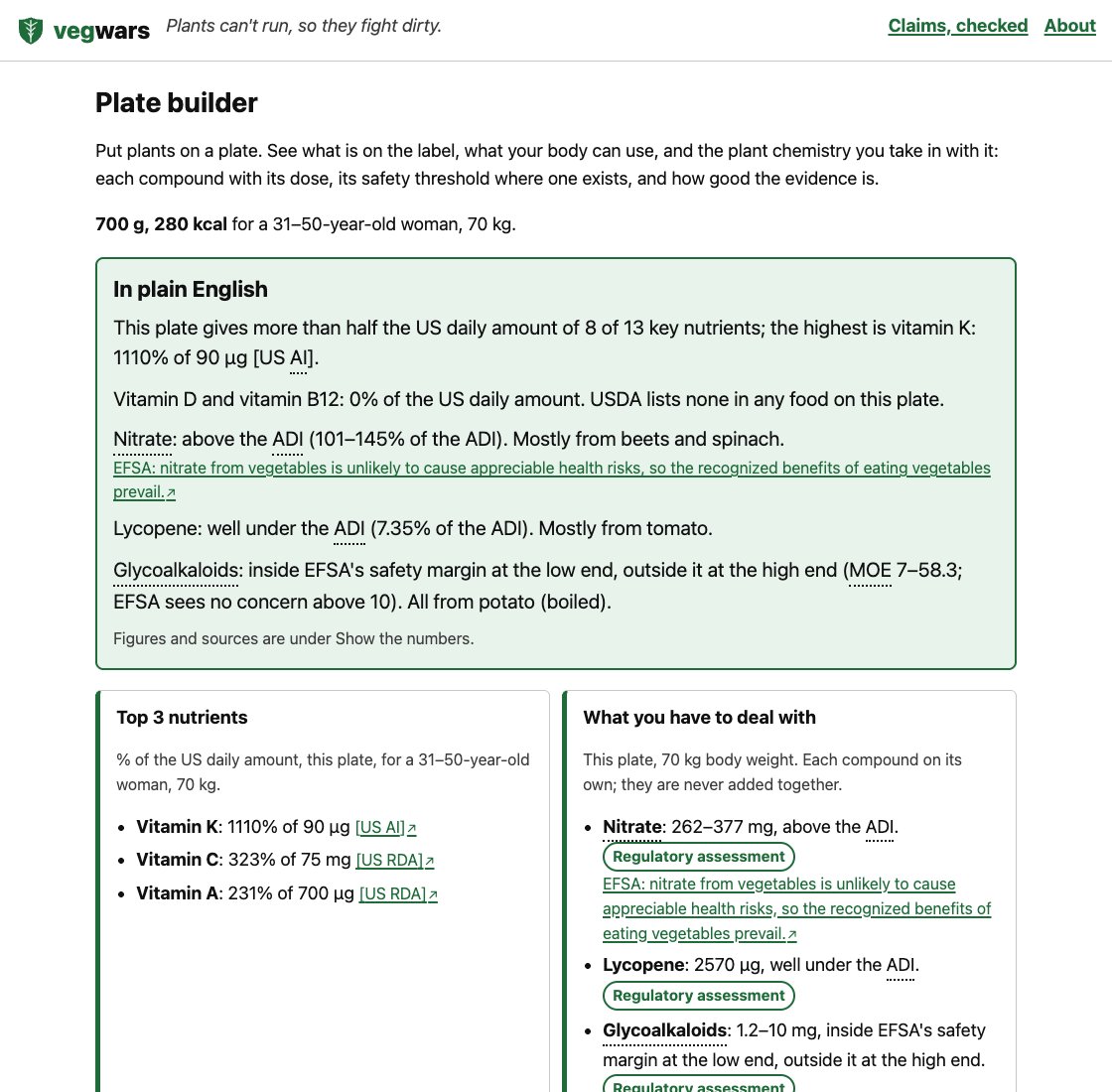
- Plate builder: put plant foods on a plate in household portions and see the label nutrients, what the body absorbs, the % of the daily amount, and each plant compound against its own limit. Compare two plates side by side, and choose whose daily amounts to use: US/Canada, UK, EU (EFSA), Australia/NZ or WHO.
- Food pages, one per plant food: a "What it fights you with" card first, then nutrients, compounds with thresholds and evidence grades, an ID card (scientific name, family, part eaten), and links to the claims that mention it.
- "Claims, checked": one popular claim per page, with a short answer, sourced quotes, a verdict per point, and a table worked out from the data files. Some tables recalculate for the reader's body weight.
- Built for the US first: US food names come first, with the UK name in brackets, US spelling, and US daily amounts by default. It works for readers anywhere.
- As of 2 Nov 2026: 46 plant foods from 15 plant and fungus families, and 58 pages in the sitemap. Behind them are 104 USDA food records, each with 56 to 135 nutrient values, and daily amounts for 25 nutrients from 5 bodies.
- As of 2 Nov 2026: 116 plant-chemistry entries covering 51 compounds in 45 of the 46 foods, each with one of 7 evidence grades, from regulatory assessment to case report. A further 9 entries are held back until they're checked. The 9 claim pages cite 64 distinct sources and quote 111 passages from them word for word, and 2 tables recalculate for body weight: almonds, and apple seeds with apricot kernels.
- Every page is worked out from the data files when the site is built; nothing is written as a general article. Every number links to its source. On data-table pages the build fails if a figure isn't in its source's quoted text, and each claims page was fact-checked by a second, independent review before publishing.
- Zero is shown three ways: measured, assumed zero by USDA, and not reported. Figures are rounded to 3 significant figures, as USDA does. Different compounds are never added into one total, and a food is never given one overall score.
- A static site built with Next.js and hosted on 20i. Automated tests run on every build and must pass before anything deploys, and every link is checked after each build.
Data sources: USDA FoodData Central, SR Legacy (April 2018), under CC0 1.0 (public domain); UK CoFID 2021, for the sugar and starch split only, under the Open Government Licence v3.0. Daily amounts are quoted, with source links, from the US National Academies DRI tables, the UK Government Dietary Recommendations, EFSA, NHMRC (Australia/NZ) and FAO/WHO. Safety limits and plant chemistry are cited with links, not redistributed: EFSA opinions, JECFA, the US FDA, EU Regulation 2023/915, peer-reviewed papers, FAO/INFOODS PhyFoodComp for phytate, and one pork-industry-funded US retail nitrate survey, disclosed on its page. Plant names and families come from Kew's Plants of the World Online and Species Fungorum. No Google Maps data and no scraping.


Things to try
- On the apple seeds page, change the body weight. The seed counts should change with it.
- On the plate builder, add two foods, then switch "Whose daily amount?" between US, UK and WHO.
- Open the potato page. Check the top card's figure by following its source link.
- On the arsenic page, use the links that load the rice onto the plate builder, and compare white with brown rice.
- Say whether any number has no source, or any wording reads as medical advice.
Tell us what you find with the Get in touch link below.